
Blog

Tramadol is a prescription pain medicine. Part of it works like other opioids, and part of it raises serotonin and norepinephrine, two chemicals that help control pain. Your liver also plays a big role, because it turns tramadol into a stronger form.
This helps explain why tramadol works well for one person and hardly at all for another. It also explains why tramadol reacts with so many other medicines, and why young children should never take it.
If you want the basics first, such as what tramadol is, what it treats and why it’s a controlled drug, start with our guide → link: What Is Tramadol? This article goes into more detail about how it works inside your body.
Tramadol Is Really Two Drugs in One Pill
Each tramadol tablet holds two versions of the same molecule. They’re made of the same parts but shaped like mirror images, the way your left and right hands are. The two versions do different jobs.
One version mostly raises serotonin, and it also has a weak opioid effect. The other version mostly raises norepinephrine. Both work by slowing down how fast your nerve cells soak these chemicals back up, so more of them stay active. In your spinal cord, serotonin and norepinephrine help your body turn down pain signals. With more of them around, fewer pain signals get through to your brain.
The two versions work better together than either one alone. They also cause some side effects you wouldn’t expect from a typical opioid, which we explain further down.
What Your Liver Does to Tramadol
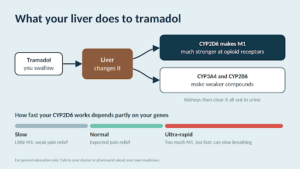
By itself, tramadol is a weak opioid. Most of its opioid effect comes after your liver changes it.
A liver protein called CYP2D6 turns tramadol into a new substance called M1. M1 is much stronger. According to the FDA label, it sticks to opioid receptors about 200 times more strongly than tramadol does. So M1, not tramadol itself, does most of the opioid work behind the pain relief.
Two other liver proteins, CYP3A4 and CYP2B6, turn some tramadol into weaker substances that don’t do much for pain. After that, your kidneys clear tramadol and its broken-down forms out of your body in your urine.
Three things can change how much tramadol and M1 end up in your blood:
- how well your CYP2D6 protein works
- other medicines that speed up or slow down your liver proteins
- how well your kidneys and liver work
The next sections go through each one.
Why Tramadol Works Differently for Different People
Your genes decide how well your CYP2D6 protein works, and genes differ a lot from person to person.
Some people have a slow version of CYP2D6. Doctors call them “poor metabolizers.” Their bodies make very little M1, so tramadol may barely help their pain, even at a normal dose. About 7 to 8 out of every 100 people of European background fall into this group. If tramadol has never done much for you, this could be one reason, so tell your doctor.
Other people have a very fast version. Doctors call them “ultra-rapid metabolizers.” Their bodies turn tramadol into M1 quickly and in large amounts. Their M1 levels can climb high enough to slow their breathing to a dangerous level, even at a normal dose. How common this is depends a lot on family background. It’s rare in some groups and much more common in others, including some North African and Middle Eastern groups.
Fast metabolism is the reason behind one of tramadol’s strictest rules. Some children died or nearly died from breathing problems after taking tramadol, some of them after surgery to remove their tonsils or adenoids. So in 2017, the FDA said children under 12 should never take tramadol, and no one under 18 should take it after those surgeries. The same worry is why the label warns against breastfeeding while on tramadol. A mother who is an ultra-rapid metabolizer can pass high levels of M1 to her baby through breast milk.
Most people have never had a gene test for CYP2D6. The test exists, but doctors don’t usually order it before prescribing tramadol. For most people, the best clues are how well the drug works and whether a normal dose makes you unusually sleepy.
How Long Does Tramadol Take to Work, and How Long Does It Last?
With the regular (immediate-release) tablet, many people start to feel relief within about an hour. Tramadol reaches its highest level in your blood about 2 hours after you take it. M1 reaches its highest level about an hour after that. The relief from one dose usually lasts a few hours, which is why doctors often prescribe it more than once a day.
“Half-life” means how long it takes your body to clear half of a drug from your blood. The FDA label gives an average half-life of about 6.3 hours for tramadol and about 7.4 hours for M1. When you take tramadol regularly, its half-life gets a little longer, about 7 hours. If you take it on a set schedule, the level in your blood levels off after about 2 days.
Kidney and liver problems slow all of this down. In people with kidney or liver disease, the half-life can be about twice as long. That’s why your doctor may space out your doses more. The long-acting (extended-release) form isn’t recommended for people with serious kidney or liver problems. Adults over 75 also clear tramadol more slowly, so doctors are usually more careful with them.
Long-acting tablets and capsules work differently. They let tramadol out slowly over about 24 hours, so the level in your blood stays more even. That’s also why you must never crush or chew them. Doing that releases the whole day’s amount at once.
How Other Medicines Change the Way Tramadol Works
Tramadol depends on your liver proteins, so medicines that affect those proteins can change how tramadol works. Some of these changes aren’t what you’d expect.
Medicines that slow down CYP2D6. Some common antidepressants do this, such as fluoxetine (Prozac), paroxetine (Paxil) and bupropion (Wellbutrin). So does the heart medicine quinidine. With one of these, your liver makes less M1, so tramadol may not ease your pain as well. At the same time, more tramadol stays in its original form. That original form is what raises serotonin, so your risk of serotonin syndrome and seizures goes up. Many of these antidepressants also raise serotonin on their own, which adds to the risk.
Stopping one of those medicines. This one surprises people. If you’ve been taking tramadol with a medicine that slows CYP2D6, and you then stop that medicine, your liver speeds back up. It starts making more M1 again, and over the next few days you could become very sleepy or your breathing could slow down. Talk to your doctor before starting or stopping any medicine while you’re on tramadol.
Medicines that slow down CYP3A4. Some antibiotics, such as clarithromycin and erythromycin, some antifungal medicines and some HIV medicines can raise the amount of tramadol in your blood. That raises the risk of seizures and serotonin syndrome.
Medicines that speed up CYP3A4. Rifampin and some seizure medicines, such as carbamazepine and phenytoin, can lower the amount of tramadol in your blood, so it may not work as well. The label says not to take tramadol with carbamazepine at all. Carbamazepine weakens tramadol, and people who take it usually have seizures, which tramadol can make worse.
Some dangers have nothing to do with your liver. Alcohol, benzodiazepines, sleeping pills and other drugs that make you drowsy all add to the way tramadol slows your breathing. For the full list of what to avoid, see → link: What Is Tramadol? .
How Tramadol’s Two Actions Cause Its Side Effects
Tramadol works in two ways, and each one causes its own side effects.
The first way is as an opioid. This part can cause constipation, an upset stomach and sleepiness. It can also slow down your breathing, which is the most dangerous side effect. And it’s the part that can make your body depend on the drug or lead to addiction.
The second way is by raising serotonin and norepinephrine. This part causes problems that most other opioids don’t. If serotonin gets too high, you can get sick with something called serotonin syndrome. This is more likely if you also take an antidepressant or a migraine medicine called a triptan. Signs include:
- feeling restless or upset
- a fast heartbeat
- fever and heavy sweating
- stiff or twitching muscles
Tramadol can also cause seizures, even at normal doses. Doctors don’t fully know why. The risk is higher at bigger doses and when you take other medicines that can also cause seizures.
Sometimes tramadol can lower your blood sugar or the salt (sodium) in your blood. Tell your doctor if you have diabetes, take a water pill, or are an older adult, because these problems are more likely for you.
In an emergency: Naloxone (Narcan) can undo the opioid part of tramadol. Give it to anyone you think has taken too much. It does not undo the serotonin part, so call 911 even if the person wakes up.
What Happens When You Stop Taking Tramadol
If you’ve taken tramadol every day for a while, your body gets used to it. Stopping all at once can make you feel sick. This is called withdrawal.
You might get the usual opioid withdrawal signs: body aches, restlessness, sweating, a runny nose, an upset stomach and trouble sleeping. Some people also feel anxious or panicky, or get tingling or quick “electric shock” feelings. In rare cases people get confused or see things that aren’t there.
Your doctor can lower your dose slowly over a few weeks, which makes withdrawal much easier. Let your doctor decide how fast to go. Never take someone else’s pills to get through it, because that’s dangerous and against the law.
Frequently Asked Questions
Is tramadol an antidepressant (SSRI)?
No. Tramadol is an opioid pain medicine. It does raise serotonin the way some antidepressants do, and that’s why taking the two together can be risky. Tramadol should not be used to treat depression.
Why doesn’t tramadol work for me?
Your liver has to change tramadol into a stronger form, called M1, for it to work well. A liver protein called CYP2D6 does this job. In some people, this protein works slowly because of their genes. In others, a medicine they take slows it down, such as fluoxetine (Prozac), paroxetine (Paxil) or bupropion (Wellbutrin). Either way, you get less pain relief. Don’t take extra tramadol to make up for it, because that raises the risk of seizures. Ask your doctor about other options.
How long does tramadol stay in your body?
Your body clears about half of a tramadol dose in about 6 to 7 hours. Most of it is gone from your blood in about a day and a half. It stays longer if you have kidney or liver problems, take the long-acting kind, or are older. Drug tests are different, because urine and blood tests can find tramadol for different lengths of time.
Is tramadol a weak opioid?
Tramadol itself is weak. But once your liver changes it into M1, it becomes much stronger. Some people’s livers make M1 very fast, and for them even a normal dose can be dangerous. So “weak opioid” can be a misleading name.
Can a gene test tell me if tramadol is safe for me?
Partly. A CYP2D6 gene test can show whether your body breaks down tramadol slowly, normally or very fast, and some doctors use it when choosing a pain medicine. It’s not a normal step before getting tramadol. A normal result also doesn’t remove the other risks, like seizures, drug interactions or addiction. Ask your doctor about the test if tramadol or codeine didn’t work for you before, or made you very sleepy at a normal dose.
The Bottom Line
Tramadol eases pain in two ways. It works as an opioid, mostly through M1, the stronger form your liver makes. It also raises serotonin and norepinephrine. How well it works for you depends on your genes, your kidneys and liver, and your other medicines. That’s why the same dose can feel very different from one person to the next. If tramadol isn’t helping, or makes you much sleepier than you expected, call your doctor before you change how you take it. [Brand] can also answer your questions about tramadol and your other medicines.
References
- U.S. Food and Drug Administration. Ultram (tramadol hydrochloride) prescribing information, Clinical Pharmacology section. DailyMed / Drugs@FDA.
- U.S. Food and Drug Administration. FDA restricts use of prescription codeine pain and cough medicines and tramadol pain medicines in children (Drug Safety Communication, April 2017).
- U.S. Food and Drug Administration. FDA updates prescribing information for all opioid pain medicines to provide additional guidance for safe use (2023).
- Clinical Pharmacogenetics Implementation Consortium (CPIC). Guideline for CYP2D6, OPRM1 and COMT genotypes and select opioid therapy.
- MedlinePlus. Tramadol drug information. National Library of Medicine.