Blog

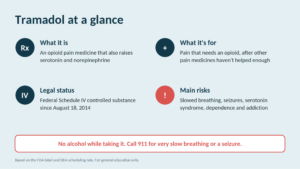
Tramadol is a prescription opioid painkiller. Doctors reach for it when pain is bad enough to need an opioid and other treatments haven’t helped enough. It also works on serotonin and norepinephrine, two chemical messengers in the nervous system, and that second action is behind some of its more serious side effects.
If you’ve just picked up a bottle from the pharmacy, you probably want to know what you’re taking and what to watch for. Below is what the current FDA label and DEA rules say, in plain English.
What Is Tramadol?
A commonly asked question is: What is tramadol? Tramadol is a man-made opioid painkiller. The FDA approved it in 1995 under the brand name Ultram. Generics came later, along with long-acting versions and combination pills. Most people who fill a tramadol prescription in the U.S. today get a generic.
It comes in a few forms. The regular immediate-release tablet is the most common, and it’s the one you’re most likely to get after surgery or a dental procedure. Extended-release tablets and capsules release the drug slowly over a full day. There’s also a liquid for adults who can’t swallow pills. Two products combine tramadol with another painkiller: acetaminophen in Ultracet, and celecoxib in Seglentis.
You can’t swap one form for another at the same dose. If the label on your bottle isn’t what you expected, ask the pharmacist before taking it.
What Is Tramadol Used For?
Tramadol treats pain in adults, and the FDA is specific about which pain. The label for the regular tablet says it’s for pain bad enough to need an opioid, in people whose pain other treatments haven’t controlled well enough. So it isn’t a first choice for mild pain.
The extended-release version is narrower still. It’s for severe pain that lasts a long time and needs treatment around the clock every day, and only when other options have fallen short. You don’t take ER tramadol “when it hurts.” You take it on a fixed schedule.
Types of Pain It’s Prescribed For
Most tramadol prescriptions are short courses after surgery, dental work or an injury. Some people take it longer for osteoarthritis (→ link: osteoarthritis condition page) or long-lasting back pain, usually after other treatments haven’t brought enough relief.
Why Your Doctor Might Pick It
Most doctors start with something other than an opioid: acetaminophen, ibuprofen or naproxen, physical therapy, or a cream rubbed on the sore spot. Tramadol comes up when those haven’t worked or aren’t safe for you. Ibuprofen and similar drugs, for example, can cause trouble if you have kidney disease, a history of stomach ulcers or some heart conditions.
Why the Choice Is Different for Each Person
Your prescriber looks at your age, your other health problems, every medicine you take, any history of seizures, depression or substance use, and whether you’re pregnant or breastfeeding. FDA guidance tells prescribers that when an opioid is needed, they should use the lowest dose that works, of a short-acting product, for the shortest time. The agency also points out that a lot of short-term pain treated outside a hospital needs only a few days of an opioid.
How Does Tramadol Work?
Tramadol eases pain in two ways, both inside the brain and spinal cord.
First, it acts as an opioid. Tramadol, and even more so a substance your liver makes as it breaks tramadol down, switches on opioid receptors on nerve cells. When those receptors are switched on, pain signals get turned down. How much of that substance your liver makes depends partly on your genes. That’s one reason tramadol works well for some people and barely at all for others.
Second, it keeps more serotonin and norepinephrine active by slowing how fast nerve cells soak them back up. Both chemicals help control how pain signals travel up the spinal cord.
Tramadol won’t fix what’s causing the pain. A broken wrist or a worn knee joint heals on its own schedule, and tramadol makes the pain easier to live with in the meantime. (The chemistry goes a lot deeper, and our → link: Article 2 covers it in detail.)
Is Tramadol an Opioid?
Yes. You may have heard it called a “weak” or “safer” opioid, and that reputation has hung around for years. Even so, tramadol carries the same basic risks as the rest of the group. The FDA lists it with codeine, hydrocodone, morphine, oxycodone and fentanyl as an opioid pain medicine.
Why That Matters for You
Tramadol’s label carries a boxed warning, the strongest warning the FDA puts on a drug. It warns about:
- addiction and misuse
- breathing that slows down or stops
- a child swallowing even one pill by accident, which can kill
- taking tramadol with benzodiazepines or other sedating drugs
- withdrawal in newborns when the mother used it for a long time during pregnancy
- other medicines that change how the liver handles tramadol
In July 2025 the FDA told the makers of every opioid painkiller to update their labels again. The new wording explains the risks of long-term use more clearly. The agency made the change after reviewing data on misuse, addiction and overdoses, both fatal and non-fatal, in people who had taken opioids for a long time.
Dependence and Addiction Are Different Things
Physical dependence means your body has gotten used to the drug. If you stop suddenly, you may go through withdrawal. It can happen even when you take every dose exactly as prescribed, and it doesn’t mean you’re addicted.
Addiction, which doctors call opioid use disorder (→ link: opioid use disorder condition page), means you keep using a drug even though it’s hurting you, and you find it hard to stop. The odds go up the longer you take an opioid and the higher the dose. They also go up if you or close family members have had problems with drugs or alcohol. Tell your prescriber about that history, because it changes what they’ll recommend.
Is Tramadol a Controlled Substance?
Yes. Under the federal Controlled Substances Act, tramadol is Schedule IV. The DEA published the rule in July 2014, and it took effect on August 18 that year. Before then tramadol wasn’t controlled at the federal level, although ten states already regulated it under their own laws.
What Schedule IV Means
The DEA sorts controlled drugs into five schedules based on medical use and how likely they are to be misused. Schedule IV drugs have accepted medical uses and a lower risk of misuse than drugs in Schedules I to III. Benzodiazepines (→ link: benzodiazepine comparison article) such as alprazolam sit in the same schedule. Oxycodone and hydrocodone combination products are Schedule II, with tighter controls. Schedule IV is a legal category, and it doesn’t make tramadol a low-risk drug.
What Changes for You Day to Day
You need a prescription from a licensed clinician who has evaluated you. Refills are capped: a Schedule IV prescription can be refilled up to five times within six months of the date it was written, and your prescriber can allow fewer. Most states also log controlled-substance prescriptions in a prescription drug monitoring program. Your doctor and pharmacist check it before prescribing or filling, mostly to catch dangerous overlaps. Some states go further than federal law, for example, by limiting how many days’ supply you can get the first time you’re prescribed an opioid for short-term pain.
Giving or selling your tramadol to anyone else breaks federal law, even if it’s your spouse with a bad back. Buy it only from a licensed pharmacy. Websites that sell tramadol without a prescription operate illegally, and the pills they ship may be fake or contaminated. The FDA’s BeSafeRx program shows you how to check whether an online pharmacy is legitimate.
Side Effects and Serious Risks
The side effects people notice most are nausea, dizziness, constipation, headache, sleepiness, vomiting, dry mouth, itching and sweating. Many of these ease after the first few days. Constipation usually doesn’t go away on its own, so ask your pharmacist what to take for it when you pick up the prescription. Tramadol can also slow your thinking and reactions. Don’t drive or use machinery until you know how it affects you.
Two Risks to Know About
Seizures are the first. The FDA label says they can happen even at normal doses, and the risk goes up with certain other medicines or if you have epilepsy or have had a seizure before.
Serotonin syndrome is the second. Tramadol raises serotonin, so combining it with other drugs that do the same can push levels too high. Those drugs include many antidepressants (→ link: SSRI/SNRI drug pages) and the triptans used for migraines. The label also lists low blood sodium, low blood sugar, adrenal problems, big drops in blood pressure and serious allergic reactions.
Call 911 right away if someone taking tramadol:
- is breathing very slowly or shallowly
- is too sleepy to stay awake, or can’t be woken
- has a seizure
- is confused or agitated along with a racing heart, fever, or stiff or twitching muscles
- has swelling of the face, lips or throat
Naloxone (Narcan) reverses opioid overdoses and is sold without a prescription in the U.S. Ask your pharmacist whether you should keep some at home.
Who Shouldn’t Take Tramadol
Children under 12 shouldn’t take it. Neither should anyone under 18 who has just had their tonsils or adenoids removed, because of the risk of breathing problems that can be fatal. The label also advises against breastfeeding while you’re on it.
Doctors take extra care with, or choose something else for, people who have:
- a seizure disorder or a head injury
- serious lung disease
- kidney or liver disease
- depression or suicidal thoughts
- a history of substance use
Older adults and pregnant women also need a closer look before starting it.
Medicines and Substances to Avoid
Don’t drink alcohol while you’re taking tramadol. Alcohol, benzodiazepines, sleep aids, muscle relaxants and anything else that makes you drowsy add to tramadol’s effect on your breathing. Antidepressants and other serotonin drugs raise the chance of serotonin syndrome and seizures.
Some antibiotics, antifungals, antidepressants and seizure medicines change how your liver breaks down tramadol. That can make it work less well, or let it build up to dangerous levels. Before you start, give your prescriber and pharmacist a full list of everything you take, supplements included.
Taking Tramadol Safely
Take it the way it’s prescribed. If pain breaks through between doses, call your prescriber instead of taking an extra pill. Don’t crush, chew or split extended-release tablets unless your pharmacist says it’s fine, because that can release a whole day’s dose at once. If you’ve taken tramadol regularly for more than a short while, don’t stop cold turkey. Your prescriber can bring the dose down gradually so withdrawal is easier.
Keep it locked up if you can, out of reach of kids, teenagers, visitors and pets. When you’re done, get rid of the leftovers. Plenty of pharmacies have drop-off kiosks for unused medicine. If there isn’t one near you, follow the disposal instructions that came with your prescription or the FDA’s guidance on disposing of unused medicines.
Frequently Asked Questions
Is tramadol a narcotic?
In everyday American usage, “narcotic” usually means an opioid, and tramadol is one. Legally, it’s a Schedule IV controlled substance. That means it has accepted medical uses and can also be misused or lead to dependence.
Is tramadol stronger than ibuprofen or Tylenol?
Comparing them by strength doesn’t really work. Ibuprofen and Tylenol (acetaminophen) aren’t opioids. Tramadol is, and it’s kept for pain those two haven’t controlled. Each has its own risks, so which one suits you depends on the kind of pain you have and your health history.
Can tramadol be addictive if I take it as prescribed?
Yes, though the risk is lower when you take it for a short time exactly as directed. Your body can become dependent even with perfect use, and addiction is possible, especially with longer treatment or a past history of substance use. If you notice cravings or catch yourself watching the clock for your next dose, tell your prescriber.
Can I drink alcohol while taking tramadol?
No. Alcohol adds to tramadol’s sedating effect and raises the chance your breathing slows to a dangerous level. It also makes you dizzier, and falls become a real risk, especially for older adults.
Will tramadol show up on a drug test?
Many basic drug panels don’t pick it up, but expanded panels often test for it specifically. If you’re being tested for work or a medical reason, tell whoever runs the test that you have a prescription, and bring proof if you can.
The Bottom Line
Tramadol is a prescription opioid that also affects serotonin and norepinephrine. It can help with pain that other painkillers haven’t controlled. It is also a Schedule IV controlled substance that can lead to dependence, addiction, overdose, seizures and serotonin syndrome, and it reacts with alcohol and many common medicines.
Take it only as prescribed, and make sure your doctor and pharmacist know about everything else you take. Keep it locked up, and get rid of whatever you don’t use. If you have questions about your prescription, side effects or other ways to manage pain, Tramadol Pharmacy can help you sort through it.